
In the five short years our local league has existed, one of the stranger challenges we’ve faced is trying to keep our soccer goals anchored. Soccer goals can tip forward, and can severely injure or even kill players when the crossbar falls to the ground. The worst are the small 6′ x 4′ goals used for U5/U6 matches because at 4′ high, the crossbar just screams ‘hang on me’ and they don’t have much weight in back to stabilize them.
There are two common methods of anchoring goals to the ground. One is sandbags laid across the rear bar of the goal. The other method is to use anchors which are driven into the ground, hooked over the rear bar of the frame. We chose anchors because sand bags seemed like a hassle to cart on and off the field, plus once the kids realized what was inside of them, we figured they would open them all the time to create their own personal sandbox. Goal anchors come in a variety of styles, including L shaped hooks, U shaped hooks, screw style anchors, and even anchors that permanently stay in the ground and attach to the goal via a short chain.
Last year, in an effort to ensure we always had enough anchors for our goals, I purchased a box of 200 L shaped hook anchors for our 32 soccer goals. That was about double the number we actually needed since we use 2-3 anchors per goal. (except on our 24′ goals – we used 4 or 5) For some reason, our goal anchors had a nasty habit of disappearing. Sure enough, by the end of last season, the box of 200 anchors was gone and we were only able to find around 30 of them scattered around the complex near the goals.
Every time the goals got moved for mowing, anchors would get lost. Some would get caught up in the mowers, causing all sorts of problems for the mowers, as well as the hooks which were usually mangled beyond recognition. Other times bored kids would pull them up and drop them on the ground when bored. I still think we had gremlins running around grabbing hooks at night. 🙂 Regardless of how they were disappearing, we never could keep the goals anchored and had to constantly run around with a bunch of anchors and a hammer, trying to anchor the goals. This was a weekly, if not daily, chore. The folks mowing the fields didn’t appreciate their blades being chewed up by metal pegs either. Clearly something had to be done.
The main problem was keeping the anchors with the goals. We talked with a local welding shop about welding short lengths of chain onto the steel hook anchors we were using. If we attached the chain to the rear bar, they’d stay with the goal so the only thing we’d have to do is hammer them back in if they got pulled out for whatever reason. The only problem was the combination of welding, chain, and quick-links to attach the chain to the goals was turning into a pretty expensive anchoring system. But we didn’t know what else we could do.
Not long after we had talked about the welded chain solution, I was flipping through a catalog from Fold-A-Goal and came across an economical heavy duty hook anchor ($2) that had an eyelet already attached to it. This would reduce the cost of welding a bit, but we were still looking at about $1-$1.50 for chain and at least $3-$4 for two quick-links to connect the chain to the goals and anchors. Plus quick-links aren’t permanent. We could tighten them up, but if they got loose, kids could undo the quick-links and remove the anchors from the goals. Then I happened to notice that wire rope (aircraft cable) was a LOT cheaper than chain per foot (less than half), and the ferrules used to make loops in wire rope were also inexpensive (about 45 cents each). This was Lowe’s pricing too – not from an industrial supply house. We didn’t need the strength of chain – just something durable that would keep the anchors attached to the goals when they were taken out of the ground.
I bought a spool of 3/32″ wire rope from Home Depot (on sale for 15 cents a foot), a ferrule crimping tool (about $25), a wire rope cutter ($34), and a bunch of ferrules (around 44 cents each). I also purchased some 1/2″ heat shrink tubing to cover the crimped ferrules which often had some sharp edges on them. After some experimentation, here’s what we came up with:
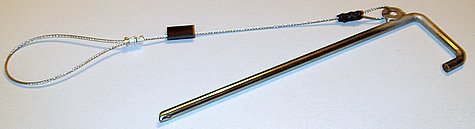
I didn’t shrink the last bit of tubing in the picture above simply so you could see the ferrule detail. So there you have it. For less than $4 per anchor, you can ensure you never lose your goal anchors again. Here’s what they look like when they’re installed on the goal.
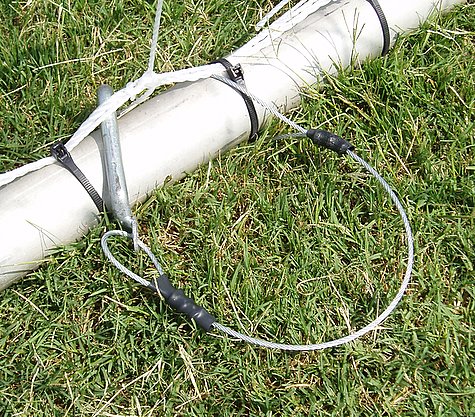
You’ll notice that this one is in the center of the rear bar, threaded through the netting attached with cable ties. Instead of assembling the big loop ahead of time, we did it at the goal itself. But you could take a completed anchor, disconnect the rear bar of the goal with a hex wrench, and slip anchors on to each end. I haven’t seen anything like this for sale – I might just make up a batch and sell them pre-assembled.
We were very happy with how these turned out. This may seem like a ‘well duh’ obvious kind of thing. But for us, it was a very clean setup that required minimal effort since the eyelets were already welded. It’s definitely a two person job, as you need someone to hold the loops steady in the ferrule while another crimps it into place. But it’s not labor intensive – just tedious when you need to do 100 or so. We’ve got two on our 6′ wide goals, 3 on our 12′ and 18′ wide goals, and 4 on our full size 24′ goals. Hopefully we won’t lose any more goal anchors and all the field marshal will need to do on game days is run around with a hammer, banging in any anchors that came loose. This will also help ensure coaches anchor goals before practice. If they don’t have to hunt down more anchors – they can simply grab the hammer and pound the anchors in if needed.
One possible improvement for these might include using more expensive stainless steel wire rope if you have fields near the ocean.
I know, I know, an entire blog post on goal anchors is pretty sad. But I thought this was a pretty cool solution to a problem that can have very serious consequences. Clearly having the anchors loose wasn’t working and our goals weren’t staying anchored. Hopefully now they will.


 Loading...



August 22nd, 2007 at 10:34 pm
Great advice. I’m looking for just this thing. Is there a model number for the L-shaped anchor with the eyelet welded on? I can’t find that at fold-a-goal or other web sites.
Our club has the same problem with vanishing anchors and unanchored goals.
August 22nd, 2007 at 10:56 pm
The model is H12E – you have to select it from the normal hook page. This should get you there:
http://fold-a-goal.com/GroupDetail.asp?GroupId=204&SKU=H12E
They’re working great so far. We think we finally figured out how to keep the backs of the nets attached to the bar too – the cable ties just don’t cut it. Post on that soon.
September 3rd, 2007 at 5:45 pm
Thanks. I’ll look forward to it. I searched for that model number and found it. I’m ordering a bunch!
September 26th, 2007 at 5:14 pm
I am glad to see that you are doing something in the way of secureing goals and hope that your idea spreads far and wide. I am the aunt of Hayden Barnes Ellias who passed away in May from the lack of soccer goal anchors.
Thank you
September 26th, 2007 at 9:35 pm
Thanks Ann – It’s been a constant struggle to keep the goals anchored. Every time you anchor them, two days later they’re all unanchored again. At least now they’re still with the goals and easy to drive into the ground again. It’s just convincing coaches that they have to check EVERY time. Few do despite repeated reminders. It can be very frustrating.
My thoughts and prayers to you and your family. What happened to Hayden was tragic.
October 8th, 2007 at 12:54 pm
We just started using “Kwik-Goal” sand bag goal weights. They are easy to move, easy to store and have not been an issue for the kids unzipping and trying to play with the sand. We put four bags (approximately 40lbs each) on the back of our 18 foot goals. That more than stabalizes the goal and helps prevent the goal from falling forward PLUS is allows the goal to “give” if a child were to run into the side post.
November 16th, 2009 at 12:04 am
What about on artificial turf?
November 16th, 2009 at 8:13 am
Well obviously you’d use sand bags there 🙂 But most of us just dream about having turf fields!
Our biggest problem with sand bags is they tend to rip open after a year if the kids don’t open them up first.
December 1st, 2009 at 9:05 am
We have just introduced a line of patent pending movable goal anchors that were designed to address the issue on artificial turf since the known sand bag issues after the first year of use. Our system will also work on natural grass.
We can install our system on any artificial turf field in the industry and with our universal adapters we can secure any brand of movable goal in the industry. Our system isn’t really for a traveling purpose, its design for the facility owner/organization to install and have their to secure the goals.
A goal can be anchored in less 1 minute with our system and releasing a goal to take it out of play takes less than minutes as well. Its designed to be easy to use but effective. Our system retracts down in the ground and store under the surface whether it be natural or artificial, allow the grass to mowed or artificial turf surface to be groomed. We have optional lock ends for our systems Key lock, Combination lock or Ball Pin Lock for so anyone can release the goal.
Learn more at http://www.secure-a-goal.com
Let me know if you have any questions
April 16th, 2010 at 8:52 pm
As a field guy, and as an engineer, I love them! Are you selling them? I’d love to have about 20 of them for our club.
April 16th, 2010 at 9:13 pm
We manufacture, sell and install goal anchors nationwide. We just finalized a contract with Kwikgoal. We provide goal assembly and anchor installation services.
Our Secure-A-Goal line of anchors will work with natural grass as well as artifitial turf. We just launch our new line of natral grass anchors that are semi-permanent and you don’t have to remove them when you disconnect the goals. They stay in the ground and you can mow the field as they are flat and just below the grass.
You can see pricing on our web site but a set of Grass Anchors (GA01) to secure two goals is less than $300. There is a volume break on the price and its on the web site.
We welcome feedback from the coaches and teams so we can engineer the products to be effective and affordable. Thanks
September 14th, 2010 at 4:32 pm
We had the same problem last year but we did weld chain to the L-shaped anchors. Rather than wrapping the chain around the goal I drilled a hole for a bolt with large washers and used it to clamp the chain to the goal. While this works well to keep the anchor with the goal it doesn’t prevent the anchor from being removed from the ground when the field isn’t supervised. Removal causes the goal to be unsafe until someone hammers it back in. To address that problem I have moved to more permanent anchors. I went to Harbor Freight and purchased their screw in anchors (maybe called tie-downs) for $15 for 6 anchors. I used 2 per goal. I screwed one of these anchors into the ground (hard work here in our rocky ground) behind each backstay on the goal then used the same cable you used except I put it with screw-together clamps. In theory those anchors should be really hard to take out because if you don’t undo the clamp the short cable should prevent unscrewing the anchor. I would suggest screwing the anchors down to the point where they are below mower height then attaching the cable with a lock (looking for very short bicycle cable locks) rather than a clamp or clip. The product from secure-a-goal looks like it accomplishes pretty much the same thing but it looked like it uses quick connect clips to attach the cable to the anchor. I can’t have anything that is easily removed because ours are at schools and parks where vandals and kids will do what they can to them if it can be done without tools or a key/passcode. I have a brand new goal which just had the 4 anchors stolen and the backbar broken in two places because I hadn’t yet put the more permanent anchors in for it yet. I assume they tipped it over then hung from the backbar to first bend then break it. It was labor intensive to put the anchors in but then we didn’t have to worry about them for the rest of the season…even when no one was supervising.
November 18th, 2010 at 5:13 pm
I like the harbor frt screw in anchors. They are actually called 15″ x 3″ canopy anchors…..and the price is right. Wire rope and clips will work for us.
April 12th, 2012 at 3:24 pm
Thanks for the solution.
I maintain a soccer field for the Kiwanis Club of Ontario, Oregon.
The goalposts keep getting moved by football players and the anchors go missing.
This will solve my anchor issue.
Thanks
Wayne